 Spaceid
 domain registration establishes Web3 name ownership for a chosen term
Spaceid domain registration gives an account ownership of an available Web3 name for a selected term on the blockchain that hosts its name service. The Spaceid 2.0 flow covers .eth, .bnb, and .arb names through Request and Register transactions. Registration establishes the registrant, while an address record supplies the destination that compatible wallets resolve. A primary-name setting determines which name represents an account address on a particular network.
Registrants, Address Records, and Primary Names
The registrant owns the domain registration, while the address record connects its readable name to a blockchain address. An account's primary-name setting identifies which name represents that account address on a particular network.
The registration term adds a time limit to ownership. Keeping that term active, choosing a receiving address, and selecting a primary name involve different management controls.
Domain Endings and Wallet Networks
The .eth, .bnb, and .arb endings identify names on Ethereum Mainnet, BNB Chain, and Arbitrum One, respectively. Spaceid 2.0 brings registration for these name services into a shared interface. The ending forms part of the domain, so the same label under another ending identifies a different name. Searching the complete name establishes which registration is under consideration.
The connected wallet must use the blockchain of the name that it is registering. A shared domain interface brings the services together without merging their networks. Management also requires the corresponding network when opening an existing name's controls.
When Does the Request and Register Flow Establish Ownership?
The Spaceid 2.0 flow establishes ownership when the Register transaction completes, after confirmation of the preceding Request transaction. It uses two transactions with distinct roles.
The registration process starts with an unregistered name and a wallet connected to its matching blockchain. The domain's information view provides the Register now action. During the Request stage, the registrant chooses how many years the registration should cover. That duration also changes the registration price.
The Request action prompts the first transaction. Its confirmation allows the process to move into the registration window. For Ethereum Mainnet .eth names, Request records a commitment, which must be at least 60 seconds old before Register.
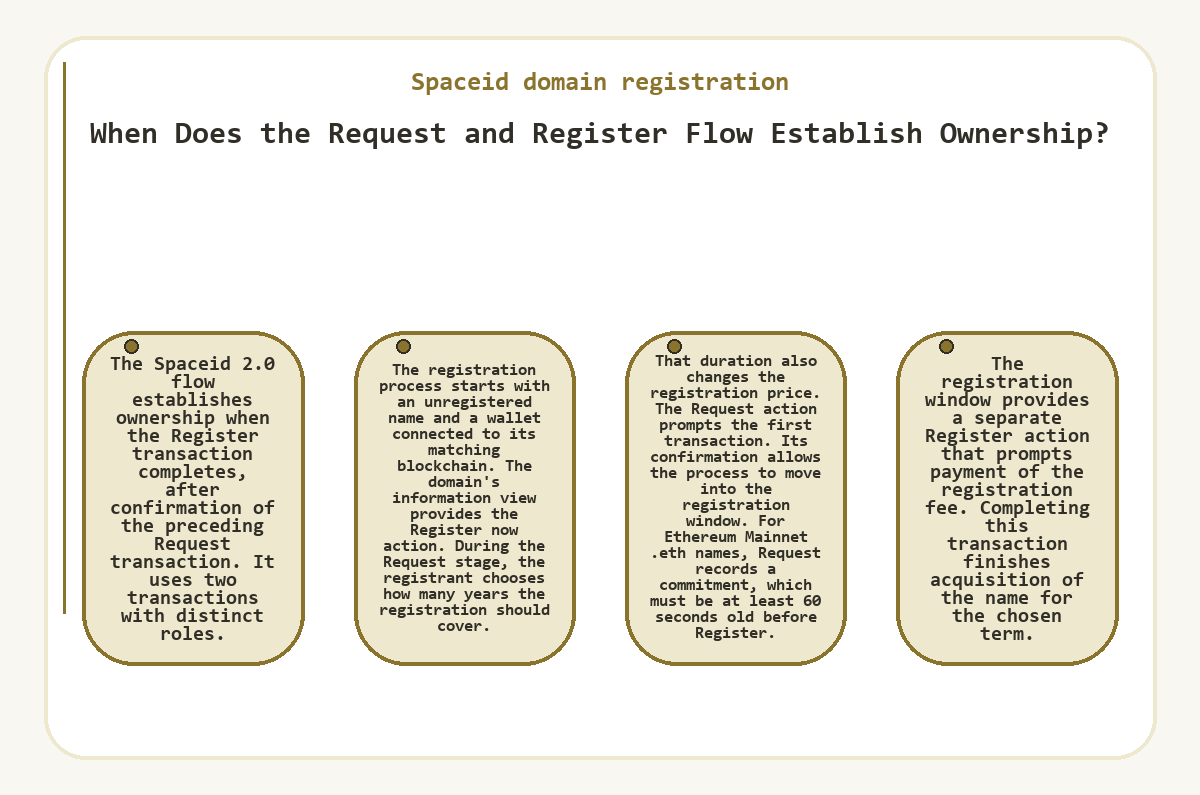
The registration window provides a separate Register action that prompts payment of the registration fee. Completing this transaction finishes acquisition of the name for the chosen term.
Registration Terms and Estimated Costs
The Spaceid 2.0 registration flow has a minimum registration period of one year, with the registration price changing alongside the selected number of years. Its total estimated price also includes gas. Compare the duration and estimated total together: extending the term changes what the registration covers, while the gas component belongs to executing the transactions.
Registration Carts Across Blockchains
A Spaceid 2.0 shopping cart can hold domains with different endings and from different blockchains, although registration processes domains on the same chain at a time. The cart groups selections before registration. It does not turn a mixed collection of names into a single registration operation across every network.
The blockchain selector beside the cart changes which network's domains the interface handles. Registering names from another chain requires switching that selection and using the corresponding wallet network.
Address Records for Name-Based Transfers
Name-based transfers send assets to the domain's record address when the sending wallet integrates the relevant name service. The readable name lets the application retrieve that destination. Trust Wallet's .bnb integration uses the address stored in the domain record.
The domain information view exposes record editing through View Details / Records, with changes made on the corresponding network. The resolved destination needs to match the intended receiving address for the transfer.
Can an Expired Registration Still Be Extended?
Spaceid 2.0 permits extension during the registration term and within a 90-day grace period after expiration. During that grace period, the name stays reserved for its previous registrant. For Ethereum Mainnet .eth names, the Ethereum Name Service's September 9, 2026 grace-period guidance states that anyone can fund renewal without changing ownership.
The Extend control appears within View Details / Records on the domain information page. The registrant can extend an active registration or renew within grace through this management control.
After the grace period, the name loses its reservation for the previous registrant and opens to public registration. For Ethereum Mainnet .eth names, a one-time premium above the standard registration fee declines to zero over the following 21 days.
Primary Selection and Ownership Transfers
Primary-name selection chooses the name associated with an account address on its corresponding blockchain. In Spaceid 2.0, an account address can have one primary name per blockchain network.
The domain must have its record address set before it can become a primary name. The account chooses a domain that uses its account address as the record address.
The My Domains interface provides edit controls in its Primary Names section.
Spaceid 2.0 provides the registrant with ownership-transfer controls. Renew an Ethereum Mainnet .eth name in grace into active registration before using Transfer. The Transfer control appears within View Details / Records and takes the new owner's address. This operation changes who holds the registration, which differs from choosing a primary name or editing a receiving address.
The Control That Matches the Name's State
The name's registration state and the intended change determine which Spaceid 2.0 control applies. Acquiring a name, configuring its use, and handing over ownership affect different properties:
- For an unregistered name, connect to its blockchain before starting Request and Register.
- For a registered name that needs a receiving destination, set its record address on the corresponding network.
- For primary-name selection, set the domain's record address to the account's address first and use Primary Names for the relevant account and network.
- If an Ethereum Mainnet .eth name is in grace, renew it into active registration first. For an ownership change, the current registrant uses Transfer with the intended new owner's address.
- For an expired name within the 90-day grace period, the previous registrant can use Extend; after grace, the name opens to public registration, with an additional, declining premium for Ethereum Mainnet .eth names during the first 21 days.
Spaceid domain registration FAQ
Where Can I Inspect a name's Character Set and Past Activity Before Registration?
The domain information page displays the name's character set and past activity. The Spaceid 2.0 registration interface offers View in full page to open that detailed view. These details help identify the exact domain under consideration before starting registration; they do not replace the name's registration status.
How Can I Find Registered Names That Are Approaching Expiration?
The My Domains view lets you sort registered names by expiration date. It also supports sorting by ending, status, and domain length. This provides a way to locate registrations that need attention without opening every name individually, while each domain's information page supplies its own management controls.
Can One Account Address Own Several Registered Domains?
An account address can own multiple domain names. Spaceid 2.0 distinguishes that portfolio from the account's primary-name selection, which identifies one name per network. Holding additional registrations does not require treating every name as primary, and the My Domains view brings the account's registered names together for management.
Does a Successful Address Lookup Confirm That a Name Is Available to Register?
A successful address lookup confirms that the resolver found an address record, not that the name is available for registration. The Web3 Name API retrieves naming data, while domain discovery provides registration-status checks. Use the registration status to distinguish an unregistered name from an existing registration.
What Happens If My Newly Registered Name Has No Address Record?
A name without an address record does not provide a resolved destination through the Web3 Name API's name-to-address lookup. Its response omits the address field when it finds no domain records. Registration ownership and address resolution describe different properties, so a missing destination does not itself establish a registration failure.
When Can I Change the Primary Name for an Account That Owns Several Domains?
Spaceid 2.0 allows an account to change its primary name at any time on the corresponding network. The replacement domain's record address must match that account address before primary selection. Each blockchain retains its own primary-name choice for that account address.
Updated