 Spaceid
 resolves payment IDs into addresses selected by chain type
Spaceid uses its Web3 Name API to resolve a payment ID into a crypto address for a selected chain type. The payment lookup takes the identifier and a text value such as evm; primary-name lookup takes an existing address and a numeric chain ID. One retrieves an address from a readable identifier, while the other retrieves a primary name for an address within a specified network context.
Jump to a section
Selecting an EVM address type does not choose the numeric network context required for a primary-name lookup.
Payment Identifiers and Address Selection
The payment resolver gives the identifier and requested address type separate roles through the
paymentID
and
chaintype
inputs.
The
getPaymentIdName
method resolves a payment ID into an address for the requested chain type.
This request belongs to the Web3 Name API's resolution tools. Domain registration concerns acquiring a name; the payment-ID method reads address information associated with an identifier. The lookup contributes that information to an application without registering a domain or changing its ownership.
Lookup Results and Payment Execution
A successful payment-ID lookup returns an address for the requested identifier and chain type. The HTTP GET operation supplies no transaction receipt or confirmation of a transfer. An application can use the address in its payment interface, but sending funds requires its separate transaction process.
Which Inputs Do Payment-ID and Primary-Name Lookups Need?
Payment-ID resolution needs an identifier and chain type; primary-name resolution needs an address and a numeric chain ID. The parameters belong to different methods, so the numeric identifier is not an additional payment-ID argument.
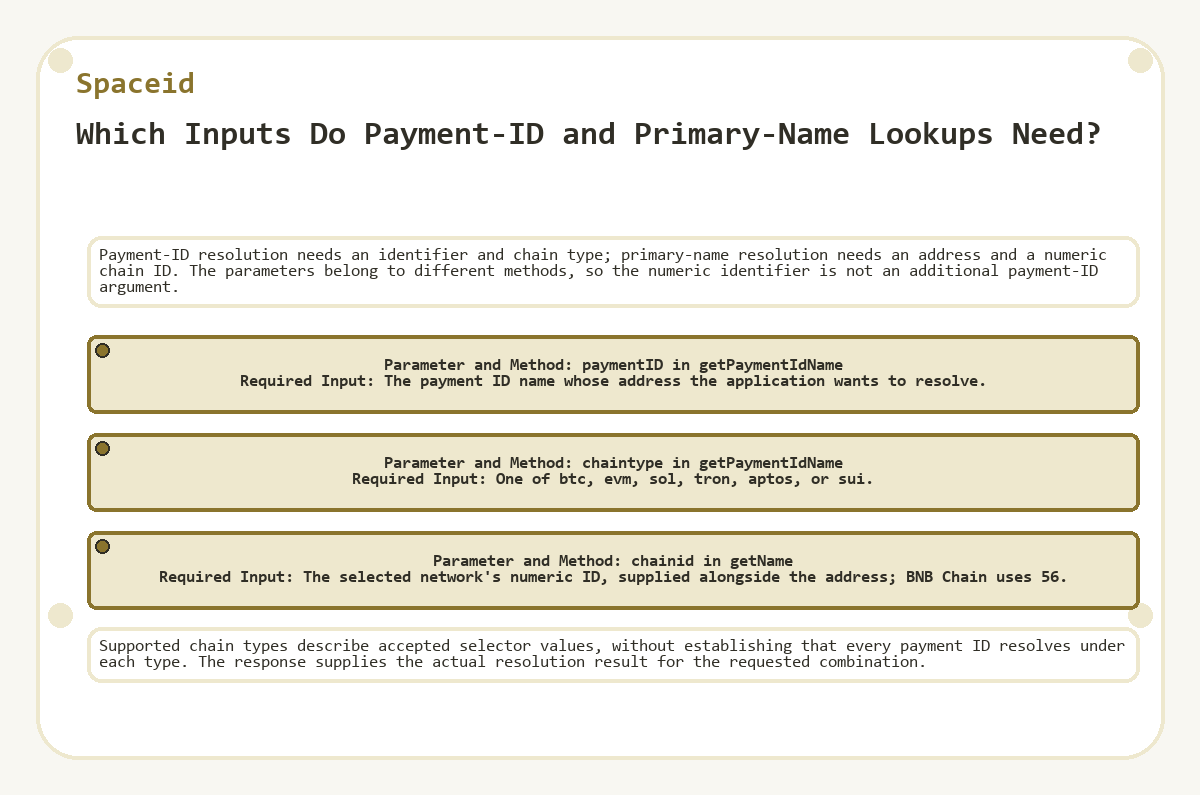
| Parameter and Method | Required Input |
|---|---|
paymentID
in
getPaymentIdName
|
The payment ID name whose address the application wants to resolve. |
chaintype
in
getPaymentIdName
|
One of
btc
,
evm
,
sol
,
tron
,
aptos
, or
sui
.
|
chainid
in
getName
|
The selected network's numeric ID, supplied alongside the address; BNB Chain uses
56
.
|
Supported chain types describe accepted selector values, without establishing that every payment ID resolves under each type. The response supplies the actual resolution result for the requested combination.
Address and Status Fields in a Response
A successful payment-ID response contains an
address
field, a numeric status code, and a short status message in one JSON object. The address appears at the top level.
The successful payment-ID response uses
code: 0
.
The same response carries
msg: success
. The status fields describe the resolution outcome, while
address
supplies the resolved value.
The single-network
getName
success response uses a different structure. Its
data
object contains
name
,
chainID
, and
errMsg
. Payment-ID parsing reads the top-level
address
, whereas primary-name parsing reads the name inside
data
.
Chain Types and Numeric Network Identifiers
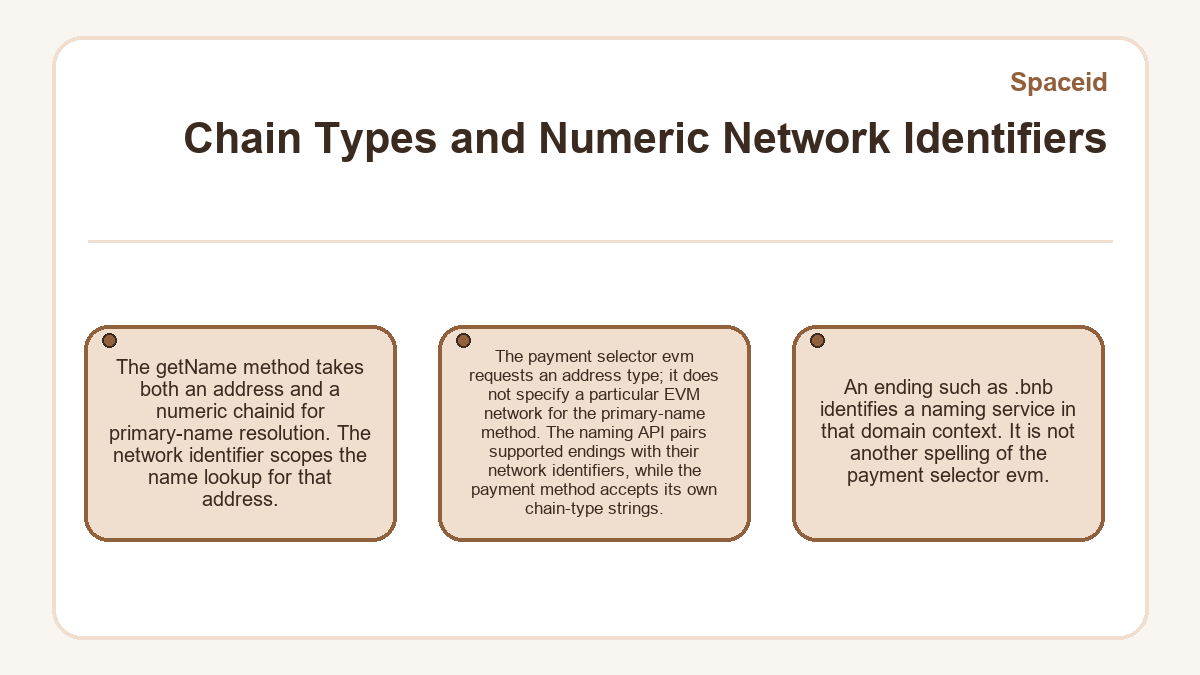
The
getName
method takes both an address and a numeric
chainid
for primary-name resolution.
The network identifier scopes the name lookup for that address. The payment selector
evm
requests an address type; it does not specify a particular EVM network for the primary-name method.
The naming API pairs supported endings with their network identifiers, while the payment method accepts its own chain-type strings. An ending such as
.bnb
identifies a naming service in that domain context. It is not another spelling of the payment selector
evm
.
EVM Chain IDs for Primary-Name Lookups
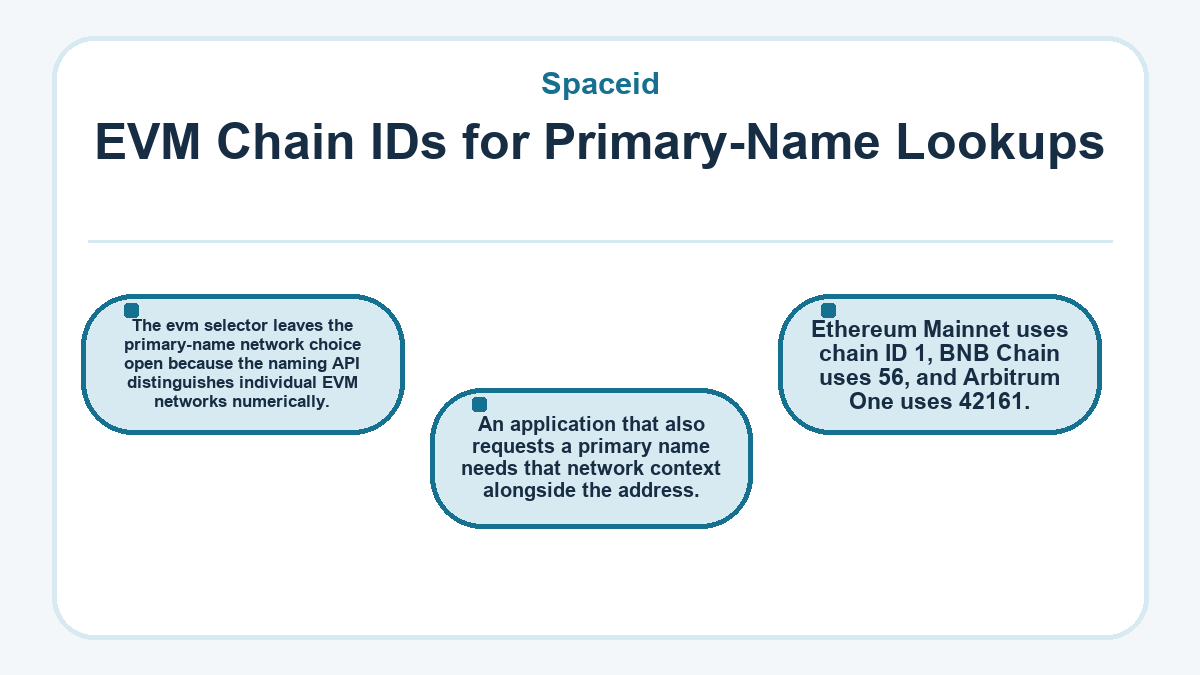
The
evm
selector leaves the primary-name network choice open because the naming API distinguishes individual EVM networks numerically. An application that also requests a
primary name
needs that network context alongside the address. Ethereum Mainnet uses chain ID
1
, BNB Chain uses
56
, and Arbitrum One uses
42161
.
Popular questions about Spaceid
Does the payment-ID Method Put Its Inputs in the Request Path?
The payment-ID method places the payment ID and chain type in path segments after getPaymentIdName. The primary-name method uses named query parameters for chainid and address. Those request formats differ even though both operations use HTTP GET.
Should I Omit @binance When Resolving Jerry@binance?
Keep the complete payment ID jerry@binance, including its suffix. That entire identifier supplies the paymentID input; removing part of it changes the name that the request asks to resolve. The requested chain type remains a separate input.
Can I Select a Transfer Asset With Chaintype?
The chaintype parameter selects the requested address type, not a transfer asset. The payment-ID request has no asset-selection or amount parameter. An application must handle those choices within its own payment process, separately from resolving the identifier.
How Do Chainid and chainID Differ in an Integration?
The primary-name request uses chainid, while its successful response uses chainID inside data. Preserve that exact casing when constructing the query and reading the result. Neither spelling replaces chaintype in the payment-ID method.
Can getName Recover the Payment ID That Produced an Address?
The getName method retrieves a primary domain name for an address and network when it finds one, rather than recovering a payment ID. An address can own multiple domains, and its owner can select a primary name. That selection does not establish the original payment identifier.
Updated