 Spaceid
 connects Web3 domain ownership with name resolution across supported blockchains
Spaceid brings domain discovery, registration, trading, and management together with tools that resolve readable names into blockchain addresses. A domain ending identifies a naming service, while its records provide information that compatible applications can retrieve. The platform combines a shared domain interface with a Web3 Name SDK and API for application integration. Its broader offering includes community name-service infrastructure and the ID token, which supports project governance.
Domain Tools and the Naming Network
The naming network connects domains with their records, while the platform supplies tools for finding, acquiring, and managing those domains. Applications use the integration layer to retrieve naming information. Each part answers a different question: which name exists, who holds it, or what its record returns. A marketplace listing, an owned domain, and a successful address lookup therefore describe different properties of a name.
These functions support several entry points. Managing an existing name involves ownership and renewal controls. An application can query records without acquiring the domain. A community launching a naming service works with a domain ending and its associated tools. Domain registration represents one way into this system, alongside trading existing names and using names through integrated applications.
Discovery and Domain Registration
Search and Registration Status
Name discovery searches across supported top-level domains, or TLDs, and offers registration-status checks, suggestions, and domain collections. The ending forms part of the name. Availability under one ending says nothing about another ending, even when the name labels match. An available registration and an existing domain listing present different ways to acquire a name.
Supported Registration Options
Domain registration obtains an available name through the relevant name service. The 2.0 platform's initial mainnet registration options included .bnb and .eth; its registration tutorial also covers .arb. Choosing an ending also chooses its associated naming service, while the platform supplies the shared access point.
Registration availability and lookup compatibility answer separate questions. A suffix in the resolution API's supported list establishes a lookup context, without promising registration availability through every interface.
Trading and Ongoing Domain Management
Marketplace Listings
The domain marketplace handles existing names and aggregates listings from other venues, including OpenSea. A listing describes an offer concerning a domain asset. It does not establish that the name contains the address record an application expects.
A marketplace listing concerns an existing registration. Its remaining registration period and renewal status remain separate from its offered sale price.
Ownership, Records, and Renewals
The management portal combines renewals, records, and ownership controls for supported domains. Its 2.0 interface covers .eth, .bnb, and .arb, with actions on the corresponding network. Only the registrant can transfer ownership. Editing a record address changes the address that integrated applications resolve. Extending a registration concerns its duration.
SDK Integration and HTTP Access
The Web3 Name SDK, a software development kit, and the HTTP API connect applications with supported naming services. The SDK packages integration functions for application code. An API, or application programming interface, exposes operations that software can request. The SDK covers address resolution, reverse resolution, records, and metadata. Its configurable chain and TLD selection lets an integration support a narrower set than the broader service. The HTTP API provides direct lookups involving domain names, primary names, and Payment IDs.
What Does Address Resolution Return?
The HTTP API returns a domain's recorded address for a forward lookup and a primary name for an address-and-network reverse lookup.
Name-to-Address Records
Forward resolution uses the complete domain name to retrieve its associated crypto address. The API's address field contains that result when a record exists. A missing record supplies no destination address. The resolver does not infer an address merely because the domain has an owner.
Primary Names and Reverse Resolution
Reverse resolution starts from an address and the relevant network identifier. An address can hold multiple domains, so a primary name identifies its selected name for reverse lookups. In the 2.0 management interface, an account can have one primary name per blockchain network. Setting the domain's record address comes before selecting that domain as a primary name.
A Primary Name Within a Domain Portfolio
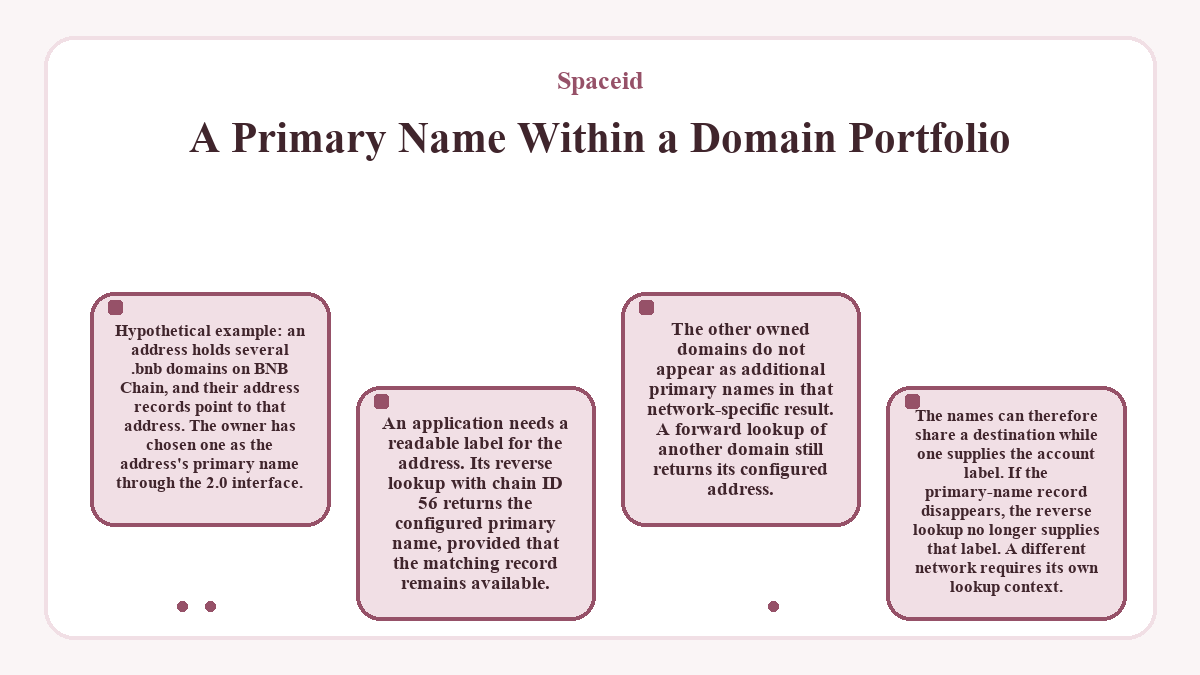
Hypothetical example: an address holds several .bnb domains on BNB Chain, and their address records point to that address. The owner has chosen one as the address's primary name through the 2.0 interface. An application needs a readable label for the address. Its reverse lookup with chain ID 56 returns the configured primary name, provided that the matching record remains available.
The other owned domains do not appear as additional primary names in that network-specific result. A forward lookup of another domain still returns its configured address. The names can therefore share a destination while one supplies the account label. If the primary-name record disappears, the reverse lookup no longer supplies that label. A different network requires its own lookup context.
Payment IDs and Token Contract Names
A Payment ID is a readable identifier for wallet addresses across supported blockchains. Its HTTP lookup accepts that identifier and an address-family selector. The HTTP API lists btc, evm, sol, tron, aptos, and sui as its chaintype values. That choice determines which kind of address the request asks for. Its parameter format differs from the chainid used for an address-to-domain query.
The .four lookup path adds a separate use for a name: resolving a token contract address on BNB Chain. A contract address identifies the token contract in that context. It should not be treated as an ordinary recipient address simply because the API returns it in an address field. The meaning of that field follows the name service and operation that produced it.
Community Name Services and the 3.0 Toolkit
Spaceid 3.0 provides infrastructure for communities that want to launch their own top-level domain and connect it with domain-management services. The toolkit covers registration, a dedicated domain NFT marketplace, management, and SDK/API support. Here, a top-level domain means the ending under which the community's names operate. Its launch route includes supplying the team with the required details, parameters, and media files.
Domains in the 3.0 toolkit can carry records such as avatars, social information, and multi-chain addresses. Those records extend an identity beyond a single address mapping. Applications that retrieve them can associate that extra information with the name. Publishing social details therefore links them to the domain's identity. Verified TLDs that join the SDK's supported set can participate in resolution and reverse resolution.
The ID Token and Project Governance
ID is the ecosystem's governance token, and its holders can participate in votes on Spaceid DAO proposals about the project. Its listed functions also include ecosystem payments, payments for Web3 Name SDK integration, and staking-linked discounts on marketplace trading fees and domain registrations. Holding a domain and holding ID describe different assets. A domain registration alone does not establish a governance-token balance.
Which Network Context Does a Lookup Need?
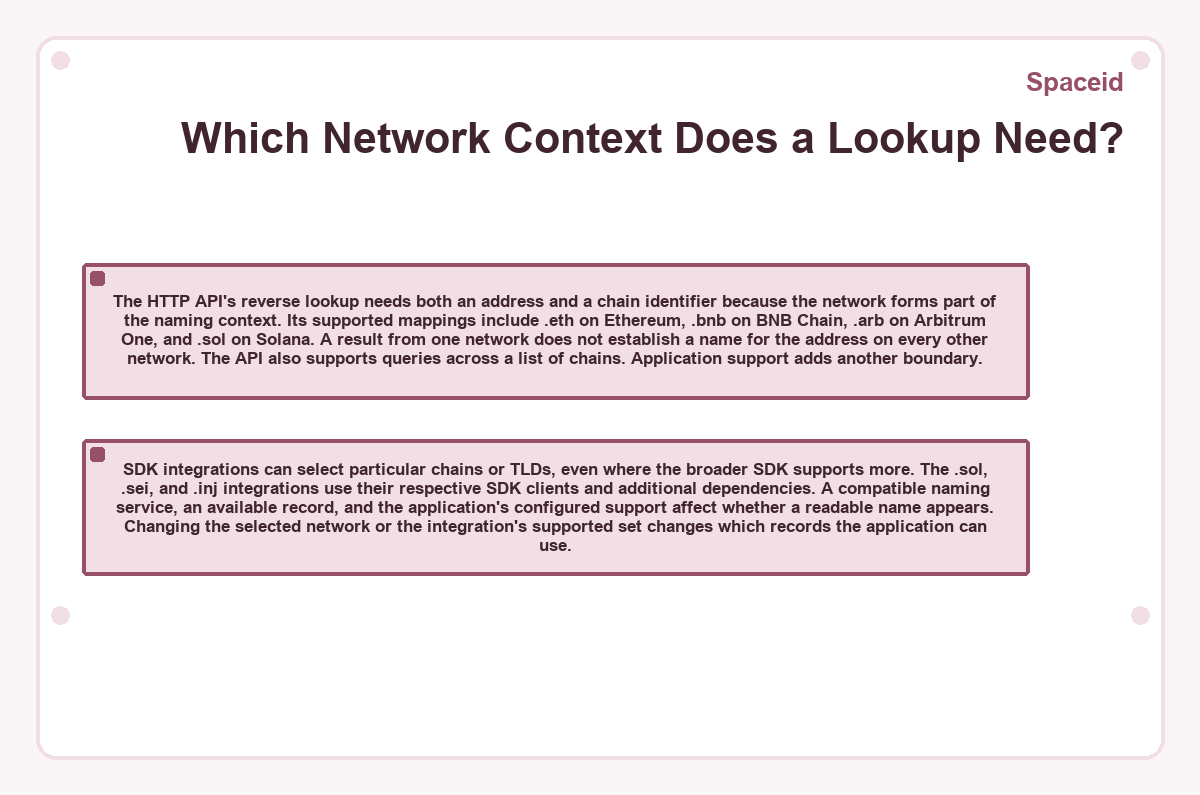
The HTTP API's reverse lookup needs both an address and a chain identifier because the network forms part of the naming context. Its supported mappings include .eth on Ethereum, .bnb on BNB Chain, .arb on Arbitrum One, and .sol on Solana. A result from one network does not establish a name for the address on every other network. The API also supports queries across a list of chains.
Application support adds another boundary. SDK integrations can select particular chains or TLDs, even where the broader SDK supports more. The .sol, .sei, and .inj integrations use their respective SDK clients and additional dependencies. A compatible naming service, an available record, and the application's configured support affect whether a readable name appears. Changing the selected network or the integration's supported set changes which records the application can use.
Practical questions
Is the Web3 Name API Free to Use?
The Web3 Name API provides free HTTP access for name-resolution requests. That pricing applies to lookup access; it does not make domain registrations, marketplace trades, or SDK integration arrangements free.
Does HTTP 200 Mean That a Domain Lookup Found a Name?
HTTP 200 alone does not establish that a lookup found a usable record. The domain and reverse-lookup responses define code 0 as found, code 1 as not found, and code -1 as an error. Applications need to read the result code and returned fields to distinguish a usable mapping from an empty or failed lookup.
Can a multi-chain Query Succeed on Only Some Networks?
A multi-chain query can return names for some requested networks and errors for others. Its result entries carry their own chain and error information. An unsupported-chain response differs from a supported chain without a matching domain. Applications therefore need to inspect individual entries even when the overall response reports success.
What Identifier Does the API Use for Solana Name Lookups?
The HTTP Web3 Name API uses chainid 900 for Solana .sol reverse lookups; this identifies Solana within that API, while its Payment ID endpoint selects an address family with chaintype, so the two parameter systems require different inputs.
When Was the Original ID early-adopter Claim Window?
The original early-adopter ID airdrop claim window was announced for March 22 to April 22, 2023, on BNB Chain. Eligibility applied to addresses holding .bnb or .arb at the campaign's snapshot, with allocation calculated per address. That historical window does not establish an open claim for registrations made later.
Updated